
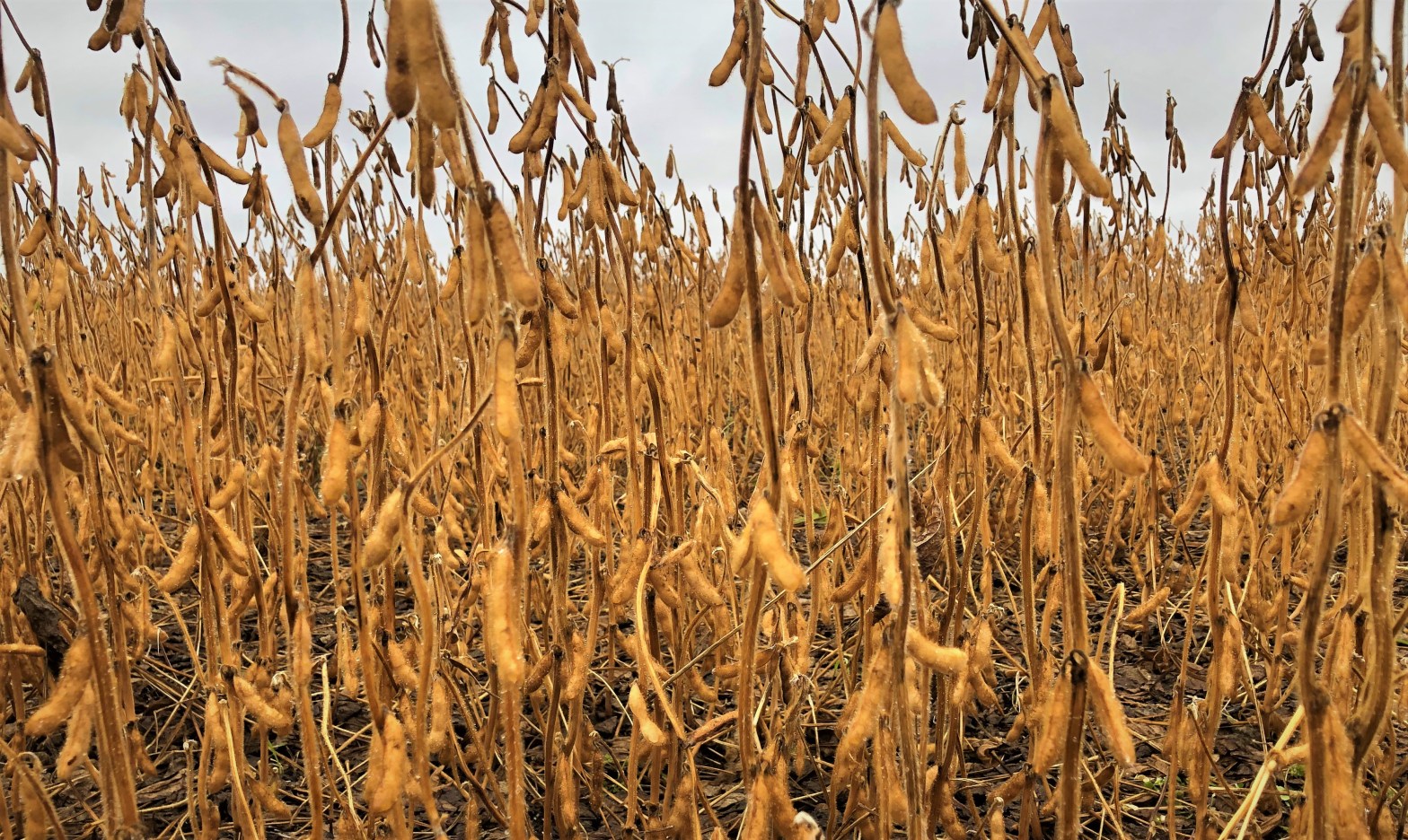
Soybeans. You’re a very interesting crop and it’s been great learning so much about you, but the last couple years have been a constant love hate relationship. Love – you give us a much needed 3 year crop rotation, you’re fairly low maintenance, and you stand great at harvest … Hate – you don’t seem to be getting the timely August rains you need, more times than not you lose the battle with volunteer RR canola poking through your canopy, and if you’re still green at the beginning of September the risk of early frost is a fear I always have. So the question I keep asking myself, do we continue this relationship or wait a couple years and then try again?
All jokes aside, the vast majority of growers in the province are still needing to complete harvest so I’m very reluctant to talk about seed, heck even the thought of mentioning fall fertilizer to some farmers kills my mood at this point. We’re fortunate to be getting some nitrogen into the ground, and the questions/comments are starting to roll in … Is it even worth it for me to grow beans again? You know, beans are going to be a very hard sell for you this fall. If I do grow beans next year, what can we do better?
Here’s a little background on my experience with soybeans. Up here in the slightly North Western part of Manitoba, they are a very new crop to us, most growers in the area only started planting them 4 years ago. Since then … we’ve had one amazing yield year, one okay year, one not so hot year, and well this year we’re not sure yet. I am optimistic though, we had a late August rain that did some good for the top pods but plants definitely did not fill to their full potential. So the top seeds are small and few, but they are there … so with that, I’ve got my fingers crossed for a 32 bu/acre average. In 2018, I partnered with a local farmer and sowed 16 very early to early season variety plot … I brought in industry professionals and encouraged hands on learning to growers in the area so we could all learn from one another. This created great discussion but yields fell short, we didn’t receive the August moisture we desperately needed, so many growers opted out of the rotational option. Sticking to what they know best, wheat and canola. I was hoping this season would and could change some minds, but the end of October is coming up quick and that wishful 40 bu/acre yield isn’t going to be a reality. We don’t even know yields yet and seed variety decisions are coming at us fast, some companies even have early booking discounts available for the end of this month. And with more and more varieties coming into the market, how does one choose what to grow out of the many choices available to them in their region? Of course, first look at CHU’s (crop heat units) and the RM (relative maturity) associated with your area. For my area, we need very early season varieties … 2275 CHU’s which equals 0.009 RM to be exact, making Syngenta’s S0009-M2 is a crowd favourite around here for those who are still optimistic about soys.
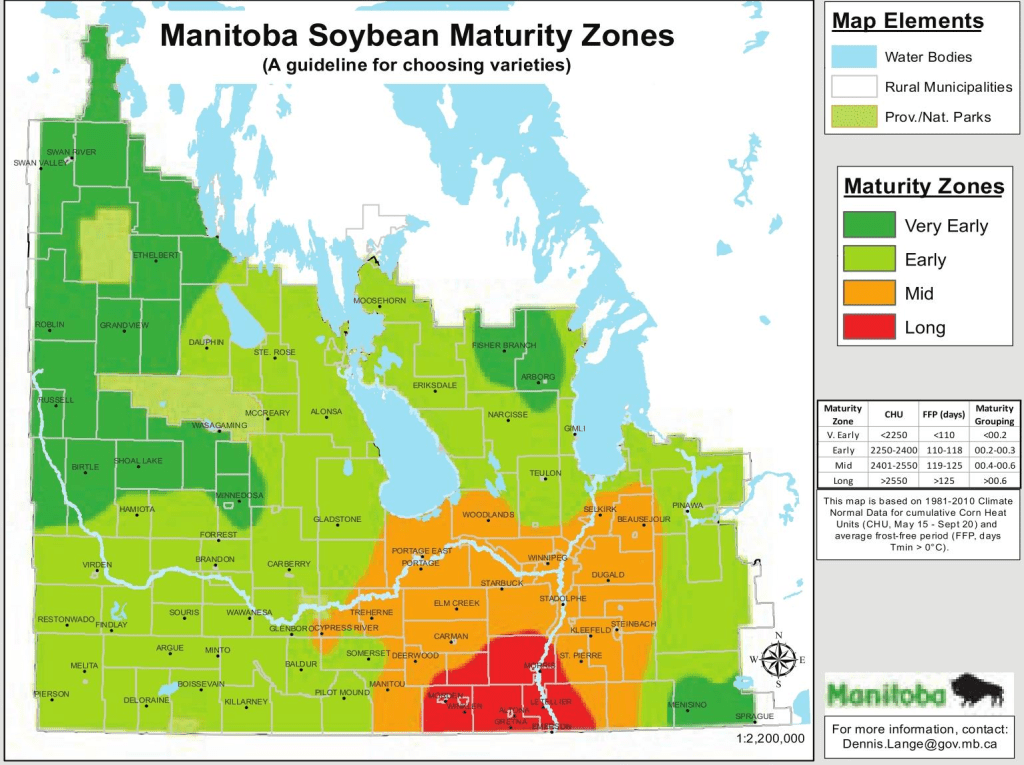
For more information on what varieties fall under the maturity zone you’re located in, check out the Manitoba Seed Guide … http://www.seedmb.ca/digital-edition/?documentID=e7139712-f01f-4eae-a035-59c74b8f9415
Now, for the farmers who are still willing to give soybeans a chance, my next step is suggesting that we do a soil test for the field(s) they’re planning on sowing beans to. Whether it be seed/variety selection or preparing the field for next year with fertilizer, the information I’m after is provided from the sample results.
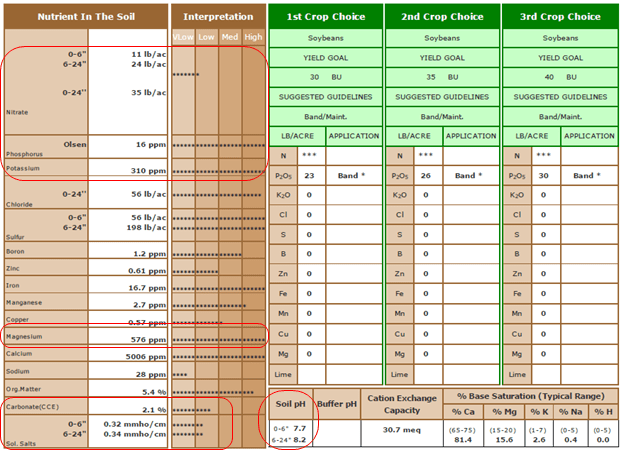
I have circled some key areas I am going to focus on.
NPK: Nitrogen. Phosphate. Potassium. Soybeans frankly are fertilizer pigs, a 40 bu/acre soybean crop will remove approximately 152 lbs/acre of nitrogen, 32 lbs/acre of Phosphate, and 56 lbs/ac of Potash. So we must pre-plan for this removal and adequately provide the crop what it needs. When it comes to nitrogen, we dual inoculate at planting … a liquid option on seed and a granular option in furrow. This provides the seed/roots with the nitrogen fixing bacteria it needs to create nodules which in turn sufficiently provides each bean plant with season long N. (Slightly off topic, but a interesting little tidbit of info, as a grower or agronomist assess your plants around the V3 stage for nodulation … at least 10 healthy (crack in half to see pink goop) nodules per plant are needed to provide the required N needs). As for phosphate and potash, don’t cut corners, especially with K. Typically for land around here, of course taking into consideration soil test results and fertilizer history, I suggest a 20P/40K or 30P/50K blend.
Mg: Low levels of magnesium in a field can present a higher potential for Sclerotinia (white mold) infection to set in. Mg deficiency issues can easily be mistaken for IDC as magnesium aids chlorophyll molecules, so if a plant is lacking it will begin to yellow interveinally. Adequate levels of Mg will also aid to increase nitrogen, phosphate, and water uptake. In my side of the province, we typically do not have to worry about low magnesium levels.
Carbonates & Soluble Salts: As a general rule of thumb to help prevent IDC (Iron Deficiency Chlorosis) symptoms … select a field with soluble salt levels of 0.8 or lower & carbonates that don’t go much higher than 2%.
pH: I’ve never really focused on pH as our soils are typically neutral to slightly alkaline. But, a presentation I attended a few years ago made mention that soybeans will perform best when soil pH levels are between 6.0-7.0, but that they prefer the low end of the 6.0 range. The presenter also made mention that planting into low pH may reduce plant structure and root development. So it doesn’t hurt to take a look at what your pH levels are!
So, what is the fate of the soybean? I know that acres of soybeans in my area are going decrease, the acres are going to go down provincially as well. Farmers are opting to a add peas, a shorter season crop, to their rotation as they’ve been yielding well and the opportunity of selling to Roquette (a protein manufacturing plant in Portage la Prairie) is now available. As an agronomist, I hope to be given the opportunity for the 2020 season to scout some soybean fields and continue to learn about the crop … so my fingers are crossed that they haven’t met their demise!





 Agronomy Nerd with a Cattle Herd