
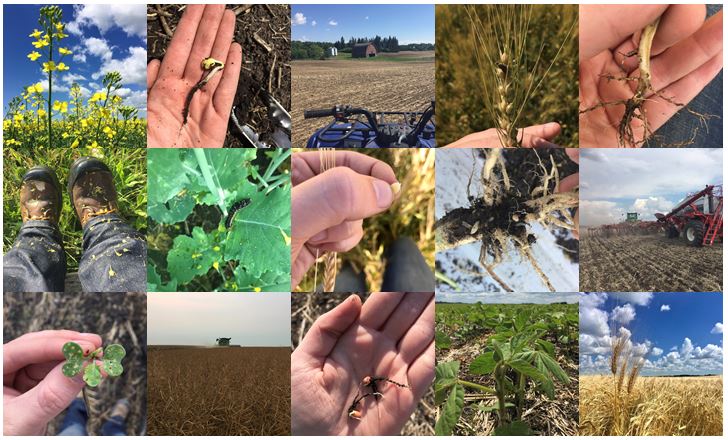
I figured there was no better time than the start of a brand new crop season to launch my website and my first blog post! Things are definitely busy in my neck of the woods, between crops being seeded and baby calves running around, I have enough going on to keep my days full. My life rarely seems to have a dull moment and I always manage to keep myself tied up with something, so let’s consider this blog my new official project. I am very excited to be (finally) starting this adventure and hope to inspire you with my everyday country living. So to kick things off, I thought I’d focus on some of the tools I have in my scouting arsenal (and by that, I mean a faded Rubbermaid tub).
Planting for the 2019 season is officially underway in Manitoba. I am employed in the north western part of the province, so some of us have got going (before this past weekend’s snow) and some of us are still itching to officially start. Wheat is typically the first crop to go in the ground around here due to the fact that cereal seed is quite cold tolerant for germination. But, that doesn’t mean a grower should jump the gun on seeding. One must take into consideration the soil’s temperature first, taking a morning and late afternoon thermometer reading (then average the two) will help you determine where your soil is at. Wheat will successfully and adequately germinate between a soil temperature of 4-5˚C (39-41˚F), and if one chooses start in colder temps, they must adjust their seeding rate accordingly (due to increased mortality potential).
So now to officially kick the 2019 scouting season off, here are the top 5 items and resources I personally think every agronomist should carry around with them in their pick-up!
#1 – Crop Protection Guides → These are a great resource to keep on hand, they never seem to leave my side and I always make sure to carry them around with me for second checking information. I’ve invested hours into tabbing and flagging important pages, so if you see a guide with my name boldly sharpie’d across the front DO NOT dare steal it (I will come looking for you). Both guides have their pros and cons but, are great resources to frequently refer to. I’m a little more so old fashioned and prefer to have the paper copy in my hands, but I have included the links below so you can access the free downloadable PDF copies.
Manitoba Guide to Field Crop Protection 2019 – https://www.gov.mb.ca/agriculture/crops/guides-and-publications/pubs/full-2019-guide-crop-protection.pdf
Alberta Crop Protection Guide “Blue Book” 2019 – https://open.alberta.ca/dataset/1be9589f-31f6-4841-a6b8-34b32e8e19b4/resource/753672e4-77b8-4a70-8cbd-08e42077a9d1/download/606-1-2019.pdf
#2 – Company Product Guides → If I am looking for specific product information I will always refer to the corresponding company guide first. These will provide you with the use crops, weeds controlled, tank mix compatibility partners & order, etc. and frankly, sometimes the crop protection guides have typos with these specifics, so I prefer to get this information straight from the each companies literature itself.
#3 – Trowel →Please, pretty please, use a trowel when you want to assess the roots on a plant. I’ve watched many simply pull a soybean plant straight out from the ground and then attempt to count the nodules on it, ummm well now you’ve ripped half them off so you’re not properly assessing anything here. Using a trowel just makes digging up plants way easier, and it conveniently fits in your truck door. So, win win.
#4 – Weed, Disease, Staging Guide, etc References → There are lots of great resources out there. Each of the provincial commodity associations provide great staging guides for each crop, as do many of the seed companies as well. For a weed ID reference, my go to is Weeds of the Prairies, my favourite feature is that it includes seedling – mature stage photos for easy identification. The Diseases of Field Crops in Canada textbook provides lots of information and photos for various diseases, and organizes each one by crop. I am a visual learner, so the more photos to reference from, the better.
#5 – Sun Screen & Bug Spray → This should be fairly self explanatory, so I am taking this opportunity to tell you a funny story. I model part time, and am signed with an agency in my home province. Last June I had a fashion photo shoot, so I modeled various outfits and looks. One of which required me to tie up the shirt I had on to expose a little bit of my stomach, I didn’t think anything of it until I got the proofs back from the photographer. They had to put them all in black and white because my arms were very notably darker than my pasty, ghost resembling stomach. Oi, we had a good laugh about it afterwards and I had to explain as to why I only tanned my arms (the true meaning of the farmers tan needed a little explanation haha).
Cheers to a safe and successful seeding season!

 Agronomy Nerd with a Cattle Herd